
This guide is for Bedford commercial property owners and their CPAs. It covers eligibility, cash-flow effects, how a study runs, how to compare proposals, and how to coordinate the result with your CPA. "Bedford" doesn't identify a state or taxing jurisdiction by itself, so state treatment depends on where your property sits. Confirm the state and county before relying on any state-level assumption.
Key Takeaways
- A study moves qualifying components into 5-, 7-, or 15-year MACRS categories.
- Value depends on basis, property type, placed-in-service date, hold plans, and taxable income.
- A solid report has engineering analysis, cost sources, and basis reconciliation.
- Compare written scope, fee, turnaround, Form 3115 support, and audit defense.
What Is Commercial Real Estate Cost Segregation?
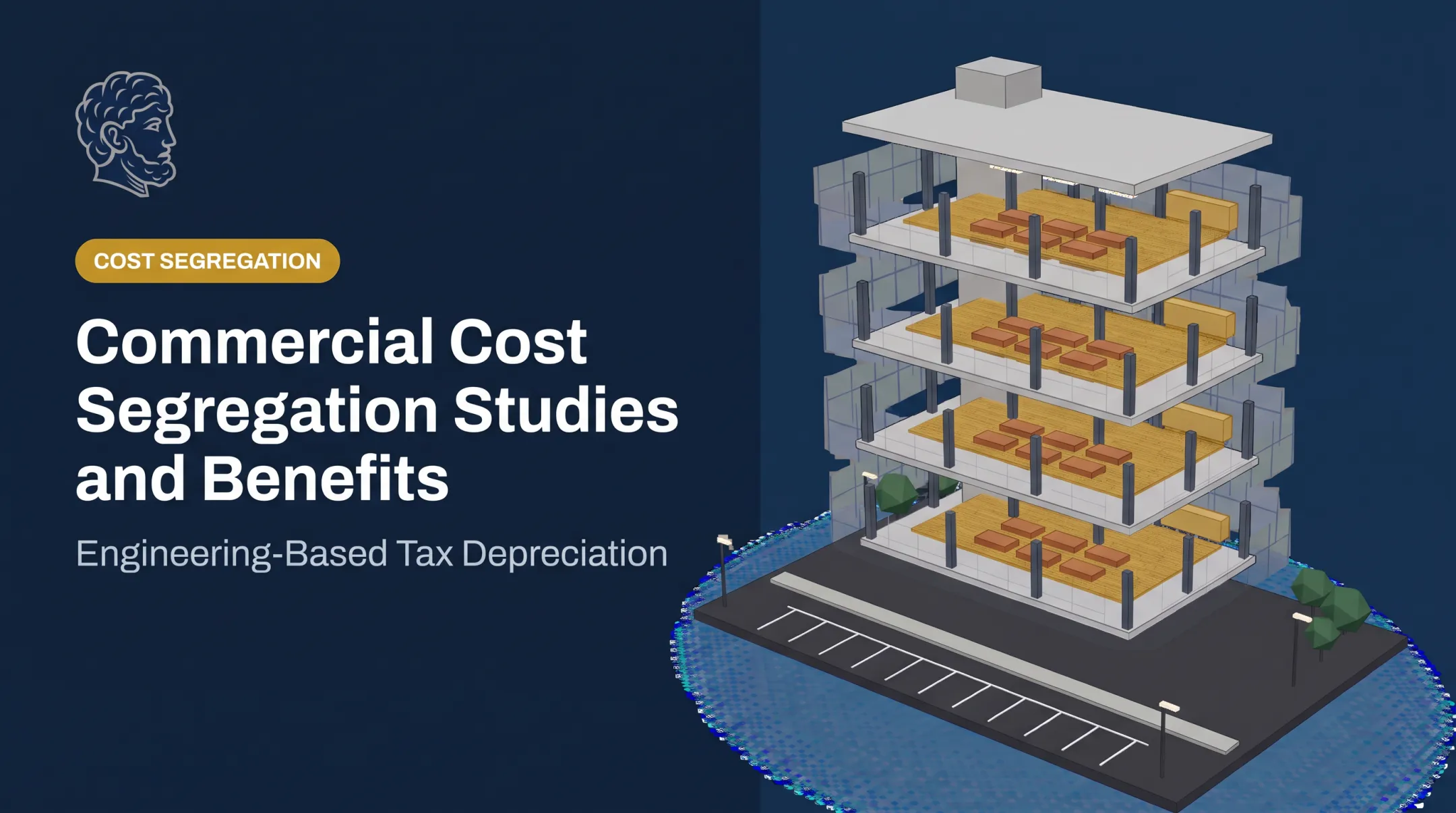
Cost segregation changes the timing of depreciation, not the total. An engineer identifies building components and site improvements that can be depreciated faster than the structural shell, then allocates supportable costs among land, §1245 property, and §1250 property.
Which components typically move
- 5-year: carpet, specialty flooring, decorative lighting, dedicated electrical and plumbing serving equipment, data and security cabling
- 7-year: certain equipment and furniture systems
- 15-year: paving, curbing, sidewalks, site lighting, fencing, landscaping, drainage
- 39-year: the structure and general building systems
The IRS does not prescribe a single methodology. It expects accurate, documented allocations based on actual costs or sound estimates, as laid out in the IRS Audit Techniques Guide. Recovery periods come from IRS Publication 946 and Rev. Proc. 87-56, which classifies land improvements as 15-year property under GDS.
What a good report documents
Each classification and cost should tie to plans, invoices, cost databases, or photographs. The report should include:
- A property-unit schedule tied to your depreciation records
- Direct and indirect costs, with cost sources identified
- A basis reconciliation your CPA can review
- Methodology, assumptions, and a preparer certification
Detailed engineering from actual cost records is generally the most methodical approach. Where records are thin, quantity take-offs apply contractor cost data to compute unit costs.
Cash-flow effect
Earlier deductions can improve near-term cash flow if you can use them. Federal law now restores 100% first-year expensing for qualifying property acquired and placed in service after January 19, 2025.

It generally covers property with a recovery period of 20 years or less, so supported 5-, 7-, and 15-year components may qualify. The building itself does not.
Whether you can use the deductions depends on taxable income, entity structure, and passive-activity limits. Rental activity is generally passive unless you qualify as a real estate professional.
What it does not do
- Creates no new basis. Over the property's life, you deduct the same total.
- Leaves land non-depreciable.
- Guarantees no refund.
- Leaves recapture in place. Accelerated §1245 depreciation is recaptured as ordinary income on sale, so review your exit plans and state conformity with your CPA.
Is Cost Segregation Worth Considering for Bedford Commercial Property?
Systems, improvements, records, and basis matter more than the property's category label.
Property types worth screening
Common candidates include:
- Office, retail, and mixed-use
- Restaurants and hospitality
- Industrial and warehouse
- Medical and care facilities
- Multifamily with five or more units
A restaurant with specialized kitchen equipment often looks very different from a plain-shell warehouse, even at similar purchase prices.
Situations that may improve the return
- Acquisitions
- Ground-up construction
- Major renovations and tenant improvements
- Expansions
- Properties with heavy site work
Don't assume savings. A property-specific analysis is the only reliable way to know.
Records to gather for an initial ROI review
- Purchase and closing documents, plus the land/building allocation
- Placed-in-service date
- Construction or renovation costs and invoices
- Existing depreciation schedules and prior returns
- Plans, ownership details, and expected hold period
Catch-up for properties bought in earlier years
If you've owned a building for years without a study, the deduction isn't lost. A look-back study can claim missed depreciation through a §481(a) adjustment on Form 3115, filed with the current-year return.
Federally, this is not done by amending prior returns. The procedure is governed by Rev. Proc. 2025-23, and your CPA must confirm the filing designation before filing.
Bedford-specific diligence
Start by identifying the property's state and municipality. States differ widely on bonus depreciation. A Tax Foundation analysis counted 15 states conforming to federal first-year expensing, a few offering a smaller fraction, and others decoupling. For look-back adjustments, state treatment also depends on whether the state followed the federal rules in the years being caught up. Confirm that treatment with your CPA.

How Does a Commercial Cost Segregation Study Work?
Scoping
The provider reviews:
- Property type and depreciable basis
- Acquisition or construction date
- Available records and your objectives
- Filing deadlines
That review shows whether a full study makes sense.
Engineering and classification
The team works from drawings, specifications, contracts, change orders, payment requests, and invoices. During a virtual or onsite tour, engineers identify and photograph components so the report reflects what is actually there.
The team allocates indirect costs pro rata or to specific assets and reconciles the total to the depreciable basis. An estimate helps you decide whether to proceed. Only the full engineered study supports the depreciation claimed on your return.

Delivery and CPA implementation
The final package should include:
- Depreciation schedules ready for the return
- Supporting calculations, methodology, and assumptions
- Form 3115 materials and the narrative, if it's a look-back
The CPA remains responsible for filing and applying the result to your facts, including state treatment and passive-loss rules.
How to Choose a Commercial Cost Segregation Provider in Bedford
Check qualifications
Confirm these points before you engage:
- Who performs the engineering and who reviews the study
- Which commercial property types they have handled
- Whether they work directly with your CPA
The IRS Audit Techniques Guide treats a construction engineer's study as generally more reliable than one prepared without engineering or construction background, though it sets no single mandatory credential.
Compare full proposals, not headline price
Line up these items side by side:
- Total fixed fee
- Property review and site-visit terms
- Report contents and turnaround
- Revisions
- Form 3115 or look-back support
- CPA questions
- Audit-defense obligations
Skip any "market average" price claim. Scope differences make those comparisons meaningless.
Ask for a sample report
Confirm the sample includes:
- Component-level classifications and cost sources
- Basis reconciliation and stated assumptions
- Depreciation schedules
- A clear link to the IRS Audit Techniques Guide
Where Seneca may fit
Seneca is an engineering-led provider serving commercial owners and CPAs in all 50 states. It has no Bedford office. Its approach includes:
- A projected-ROI review before you commit, prepared by Engineering rather than sales
- A written fixed-fee proposal within 24 to 48 hours
- Engineering and CPA collaboration from estimate to final report
- Form 3115 prepared for the CPA to sign and file on look-backs
- Lifetime audit defense for the taxpayer and property under their ownership, including IRS requests at agent and appeals levels
Seneca does not prepare state tax returns or state adjustments, so your CPA handles those.
Verify the contracting entity
If you're comparing a Bedford-branded provider, confirm these details in the current engagement letter:
- Contracting company and assigned technical team
- Report signer and CPA-support contact
- Audit-defense scope and fee
Don't rely on an older brochure or a third-party comparison.
Frequently Asked Questions
What is commercial real estate cost segregation?
An engineering-based study separates qualifying building components into appropriate depreciation categories, potentially accelerating deductions. Results are subject to CPA review and current tax rules.
Is cost segregation worth it for a commercial property in Bedford?
It depends on depreciable basis, complexity, placed-in-service date, hold period, tax capacity, study fee, and federal and state rules. Request a property-specific ROI analysis.
How much does a commercial cost segregation study cost?
Fees vary with property size, complexity, records, engineering scope, site-visit needs, and deliverables. Ask for a written fixed-fee proposal that lists exclusions and support terms.
Does a commercial cost segregation study require an on-site visit?
Not always. The IRS guide describes a site visit as part of a quality study, but the need depends on documentation and scope. Large, specialized, or new properties benefit most from onsite review.
Can I do a cost segregation study on a property I bought years ago?
Often, yes. A look-back study may involve Form 3115 and a §481(a) adjustment. Your CPA must confirm the procedure and filing treatment.
Does a cost segregation provider replace my CPA?
No. The provider supplies the engineering analysis and depreciation study. Your CPA evaluates usability, state treatment, filing positions, passive-loss limits, and implementation.