
Federal bonus depreciation rules have shifted recently, and the old phase-down schedule still circulates online. Owners and CPAs now need to separate two things. Cost segregation identifies and reclassifies qualifying building components. Bonus depreciation determines how fast eligible components can be deducted.
What you actually get depends on current federal law, state conformity, property facts, and whether you can use the deductions.
Key Takeaways
- Cost segregation generally accelerates existing depreciation; it does not create a new deduction.
- A study documents which components may qualify; bonus depreciation is a separate provision.
- Verify 2026 eligibility, state rules, loss limits, and recapture with a CPA.
- Request an ROI analysis before engaging, so the tax benefit can be weighed against the cost.
Cost Segregation and Bonus Depreciation: What Each Strategy Does
What cost segregation changes
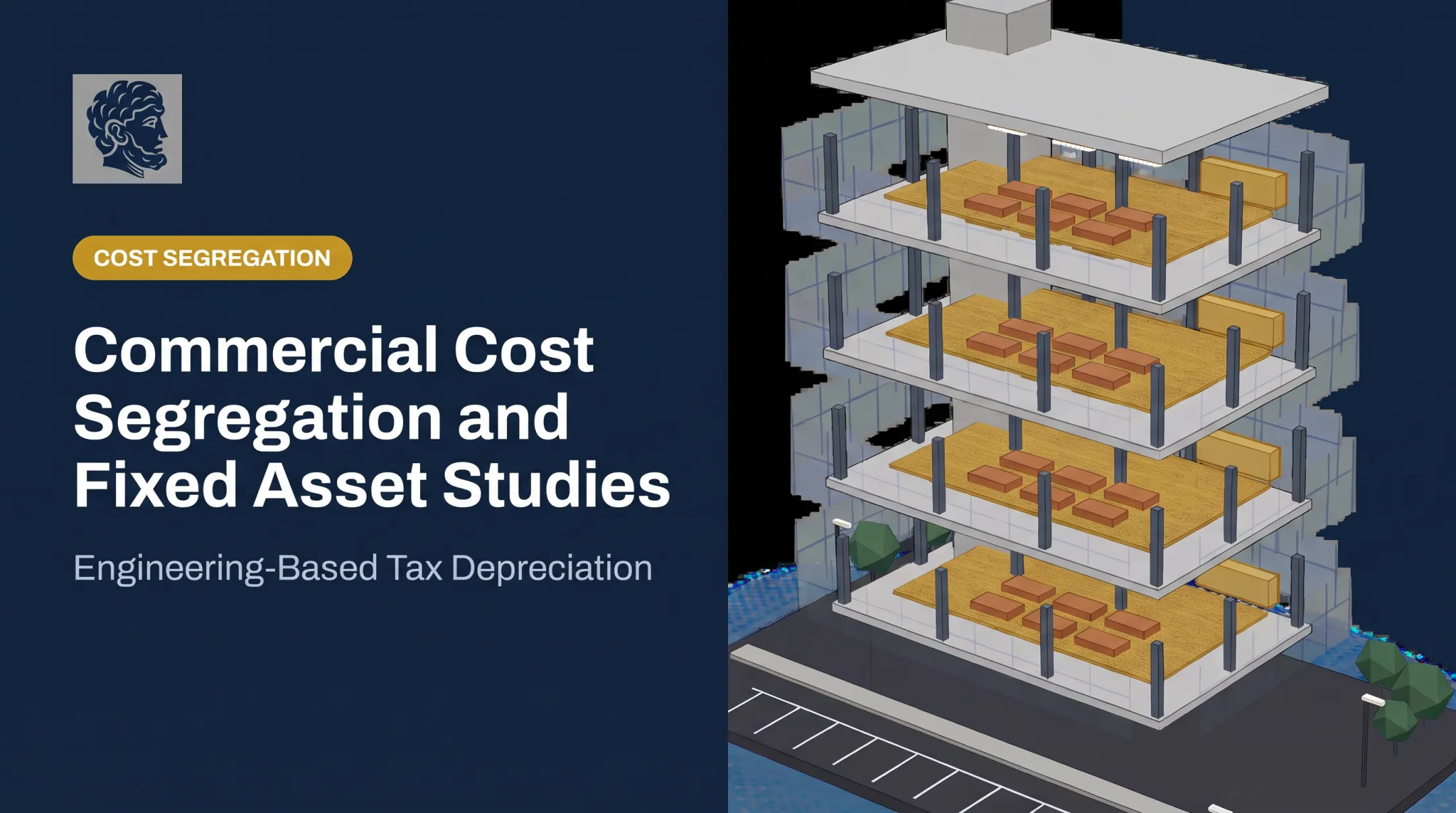
A cost segregation study is an engineering-based analysis that breaks a property into components and assigns each to the correct tax recovery category. Without one, a purchase is often booked as two lines: land and everything else. With one, it becomes land, structure, land improvements, and personal property.
Examples of what a study separates:
- Structural property: windows, general building branch circuits, and the shell
- Personal property: specialty flooring, cabinetry, millwork, dedicated electrical serving equipment
- Land improvements: paving, landscaping, fencing, site lighting
Under IRS Publication 946, the main federal recovery periods are:
| Category | Recovery period |
|---|---|
| Personal property (most items used with residential rental property) | 5 years |
| Readily removable awnings, window treatments | 7 years |
| Land improvements, qualified improvement property | 15 years |
| Residential rental property | 27.5 years |
| Nonresidential real property | 39 years |
Land is never depreciable. Classification is fact-specific, so no component is automatically 5-year property.
How bonus depreciation interacts with the study
Bonus depreciation lets qualifying property be deducted faster than under regular depreciation. Eligibility generally requires a recovery period of 20 years or less.
The 27.5-year and 39-year building shell falls outside that, so completing a study does not make a whole building bonus-eligible. The study identifies the components that qualify and excludes structure and land.
Hypothetical example (illustrative only, not a promise of savings): An investor buys a $5,000,000 nonresidential property. Assume $1,000,000 is land. Of the $4,000,000 building basis, assume a study assigns $800,000 to 5-, 7-, and 15-year property.
- Regular depreciation: the full $4,000,000 is spread over 39 years, roughly $102,000 a year in the first full year.
- Cost segregation with 100% bonus: $800,000 is deductible in year one, and the remaining $3,200,000 continues over 39 years.
At an assumed 30% combined tax rate, the extra year-one deduction defers roughly $210,000 in tax. The total deduction over the property's life stays the same; only the timing changes. Your results will differ based on your own assumptions.

What the strategy does not do
Accelerated depreciation shifts deductions earlier, so later years have less to deduct. The benefit is time value of money.
It may also be limited by:
- Insufficient taxable income
- Passive-activity and at-risk rules
- Basis limitations
- The excess business loss limit
2026 Federal Bonus Depreciation Rules and Eligibility
Verify the current law before quoting rates
Public Law 119-21, enacted July 4, 2025, makes 100% bonus depreciation permanent for qualifying property acquired after January 19, 2025. Property acquired under a written binding contract signed before that date is not treated as acquired after it.
Older TCJA schedules list 40% for 2025 and 20% for 2026. Those are legacy rates, not the general federal rule for property qualifying under the new law. For the first tax year ending after January 19, 2025, a taxpayer may still elect a reduced 40% rate instead of 100%.
IRS Notice 2026-11, published February 2, 2026, is interim guidance covering contract rules and self-constructed property. Proposed regulations are expected, so check for updates before filing.
Which real estate components may qualify
Bonus follows shorter recovery periods. Commonly cited candidates include:
- 5-year: carpet, millwork, specialty lighting, dock levelers
- 7-year: furnishings, cranes, hoists, material-handling assets
- 15-year: paving, landscaping, fencing, yard lighting, qualified improvement property
Qualified improvement property is limited to interior improvements to nonresidential buildings made after the building was first placed in service. It excludes enlargements, elevators, escalators, and the internal structural framework.
Used property can qualify, but the taxpayer or a predecessor generally cannot have had a depreciable interest in it during the prior five calendar years. Related-party and carryover-basis restrictions also apply.
The shell, structural framework, and elevators stay on 27.5- or 39-year lives, and land is not depreciable.
Timing, elections, and state conformity
"Placed in service" means the property is ready and available for its assigned function. That date, together with the acquisition date and construction status, drives which rules apply.
Even when property qualifies, bonus depreciation is optional. Taxpayers may elect out by property class, using Form 4562 with a statement attached to a timely filed return, including extensions. Because the election covers an entire class for the year, a CPA should model it before filing.
State rules vary. Bloomberg Tax notes Massachusetts requires an addition modification for corporate taxpayers, and Tennessee has stayed coupled to the old schedule. Model federal, state, and combined benefit separately.

Seneca does not prepare state returns or state adjustments, so that analysis belongs with your CPA.
When the Strategy May or May Not Make Sense
Owners and properties that should be evaluated
Newly acquired, newly built, renovated, and owner-operated properties can all be candidates. So can multifamily, industrial, hospitality, retail, medical, office, and self-storage assets. Property type matters less than basis, renovation scope, ownership structure, tax rate, expected income, and hold period.
A quick screening checklist:
- Placed-in-service date
- Depreciable basis, excluding land
- Recent improvements
- Current tax capacity
- Expected hold period
- States where the property sits
- Availability of construction records
Existing properties and look-back studies
If you have never completed a study, a look-back study can capture missed depreciation. The catch-up is generally taken through an accounting method change on Form 3115 with a section 481(a) adjustment, without amending prior returns.
The CPA confirms eligibility, filing requirements, and whether the deduction is usable this year. A building held for several years can produce a larger single-year deduction because missed years arrive at once.
Renovations and partial asset dispositions
A study before renovation documents the tax basis of components being removed. That supports a partial asset disposition election under Treas. Reg. 1.168(i)-8, made on a timely original return.
New improvements may be classified differently from the original building, so retain invoices, plans, and photographs to support the filing.
Tax utilization and exit planning
The largest calculated deduction is not always the most valuable one. Passive losses, suspended losses, thin taxable income, or basis limits can delay the benefit.
Passive rules matter especially: per IRS Publication 925, rental activities are generally passive unless the taxpayer qualifies as a real estate professional.
Exit timing shapes the net result:
- Section 1245 gain is ordinary income to the extent of depreciation taken
- Unrecaptured section 1250 gain is capped at 25% for individuals
- A 1031 exchange can defer recognition, with its own recapture rules
Compare after-tax cash flow across several years and exit scenarios, not just the first-year deduction.
How a Cost Segregation Study Works
Engineering and tax analysis
A cost segregation study typically follows this sequence:
- Collect closing statements, plans, pay applications, and prior returns
- Review invoices and drawings
- Tour the property, onsite or virtually
- Group assets and substantiate component costs
- Prepare the classification analysis and report

The IRS Audit Techniques Guide favors detailed engineering from actual cost records because it minimizes estimates. Engineering knowledge matters for distinguishing structural systems from dedicated or specialty assets.
For example, a study might allocate part of a building's electrical distribution to equipment-serving circuits in a specialized kitchen.
Report quality and documentation
Expect the report to include:
- Property background and methodology
- Asset classifications with reasoning
- Cost support and depreciation schedules
- Assumptions
- Reconciliation to your tax basis
The IRS Audit Techniques Guide treats these as quality indicators. It is examination guidance, not law. A good report preserves records for the return, future renovations, dispositions, and audits.
Coordination with the CPA
The provider supplies the technical analysis. The CPA decides how to apply it: modeling limits, making elections, and handling state treatment. Involve the CPA early so the study fits the broader tax plan. For look-back studies, Seneca prepares the Form 3115 narrative, calculations, and schedules, and the CPA signs and files.
Evaluating ROI and Choosing a Provider
An ROI framework
Compare the projected after-tax benefit and its timing against:
- The study fee
- Implementation and administrative effort
- State impact
- Expected hold period
- Potential recapture
No universal benchmark exists, so avoid any provider promising a fixed return. A strong provider gives a preliminary estimate and states its assumptions. It should also show how results change with tax rate, income, bonus percentage, hold period, and exit.
Questions to ask a provider
- Who performs the engineering, and what is their experience?
- What methodology do you follow?
- Do you review the site, in person or virtually?
- Is there a tax review, and how do you work with my CPA?
- What does the report document?
- Is pricing fixed-fee and written?
- What is the turnaround time?
- Can you sign an NDA?
- What audit support is included?
Where Seneca fits
Seneca is an engineering-led provider that helps commercial property owners and CPAs evaluate projected ROI before engagement. Typical engagement terms include:
- Written fixed-fee proposal within 24 to 48 hours
- Lifetime audit defense while you own the property
- Studies completed in about 2 to 5 weeks
An estimate is not a tax conclusion. Your CPA should review it before filing.
Conclusion: Make Depreciation Planning Part of the Real Estate Strategy
Cost segregation and bonus depreciation can improve deduction timing. The outcome rests on accurate engineering classification, current law, tax capacity, state treatment, and your investment plan.
Before you commission a study:
- Gather property records
- Ask your CPA for a current-law review
- Get a documented ROI estimate
Based on federal guidance available through November 2026. Depreciation law changes, so confirm current rules.
Frequently Asked Questions
Can you take bonus depreciation on a commercial building?
Not on the whole building automatically. The 39-year shell does not qualify, but components identified through cost segregation may. Check 2026 federal rules and your state's conformity.
What is cost segregation and how does it relate to bonus depreciation?
Cost segregation identifies and classifies building components by recovery period. Bonus depreciation is the separate tax provision that may accelerate deductions for qualifying components.
What are the rules for bonus depreciation and cost segregation in 2026?
Federal law now provides 100% bonus for qualifying property acquired after January 19, 2025. Don't rely on old phase-down schedules; confirm IRS guidance, elections, used-property rules, and state differences.
What assets are eligible for 100% bonus depreciation?
Eligibility depends on recovery period (20 years or less), acquisition and placed-in-service dates, use, and taxpayer circumstances. Components such as 5-, 7-, and 15-year property can qualify; the building shell and land cannot.
Which depreciation method is used for tax purposes?
MACRS, generally under the General Depreciation System. Buildings use straight-line over 27.5 or 39 years, while shorter-lived components use faster methods. A study determines which components get which treatment.