
Introduction
Sometimes, yes. A commercial cost segregation study pays off when four conditions line up:
- Enough depreciable basis on the property
- Enough components that qualify for shorter lives
- An owner who can actually use the deductions
- A holding period long enough to benefit
Miss one of those and the math can turn thin.
There is no universal purchase-price cutoff and no reliable savings promise. Anyone quoting a flat percentage before looking at your property is guessing. This article gives owners and CPAs a framework for running a property-specific ROI analysis: what the study does, when it fits, how to calculate net benefit, how 2026 rules affect the math, and how to vet a provider.
Key Takeaways
- Cost segregation accelerates depreciation you already have; it does not create new deductions.
- The best candidates combine large depreciable basis, shorter-life components, usable taxable income, and a multi-year hold.
- Net benefit must account for fees, CPA work, passive loss limits, state tax, recapture, and sale timing.
- Use an engineering-based study, documented in detail and coordinated with your CPA.
What Is a Commercial Cost Segregation Study?
What cost segregation changes
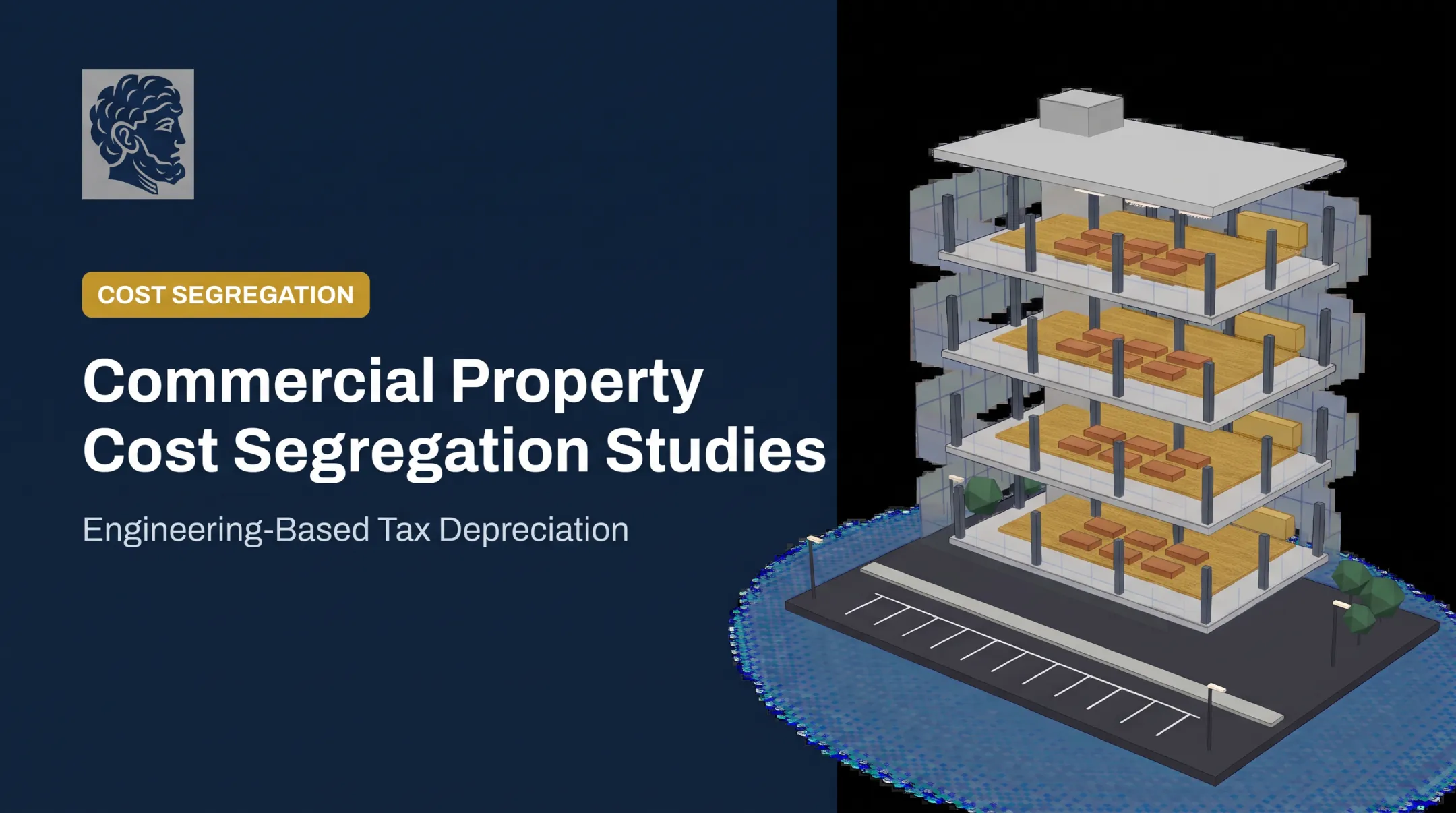
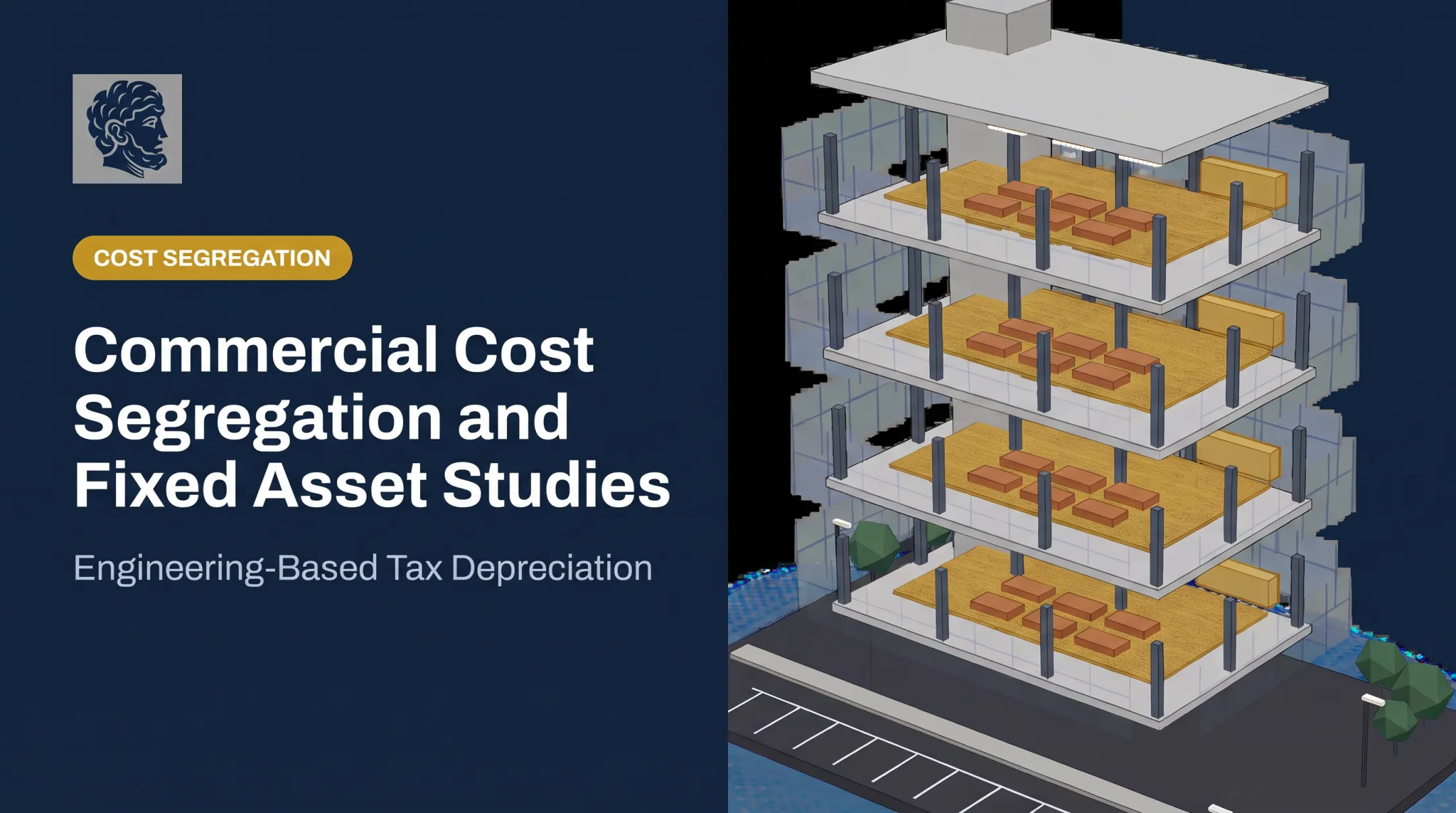
A cost segregation study is an engineering and tax analysis that breaks a building into components with different recovery periods. Without one, a nonresidential building is generally depreciated as a single asset over 39 years. The IRS Audit Techniques Guide describes the work as identifying property components and allocating costs to the proper classes.
The general recovery periods look like this:
| Property category | Recovery period |
|---|---|
| Land | Not depreciable |
| Residential rental building | 27.5 years |
| Nonresidential building | 39 years |
| Qualifying personal property | 5 or 7 years |
| Qualifying land improvements | 15 years |
Total lifetime deductions stay the same. The study moves them out of later decades and into early ownership years.
Typical commercial candidates include:
- Dedicated electrical and plumbing serving equipment
- Specialty flooring, millwork, and decorative lighting
- Tenant build-outs
- Paving, fencing, site lighting, and drainage
Classification depends on the facts of each property, so none of these is automatic.
How the study is prepared
A typical engagement runs through these steps:
- Initial consultation and information collection (closing statements, plans, invoices, prior returns)
- Virtual or onsite site tour, with components identified and photographed
- Engineering classification and cost allocation
- Tax review and reconciliation to total cost
- Final report with schedules your CPA can use

A defensible report documents its methodology, asset descriptions, cost sources, recovery-period conclusions, and supporting tax authority. The IRS guide cautions against unsupported rule-of-thumb percentages. An online estimate is a useful first screen, but only a completed engineering study provides the substantiation needed for tax reporting and audit support.
When Is a Commercial Cost Segregation Study Worth It?
Financial factors that strengthen the case
Start with depreciable basis, not purchase price:
- Land comes out
- Acquisition costs, construction costs, and later improvements go in
For a lump-sum purchase, a pro-rata step-up isn't acceptable. The IRS guide uses a $5 million warehouse example with $1.88 million of land value to make this point.
How much can be reclassified depends on the building's design, specialty systems, site work, tenant build-outs, and renovation history. No authoritative source supports a standard percentage by property type.
Tax position and ability to use deductions
Accelerated depreciation only helps if you can use it. Watch for:
- Passive activity rules: Rental real estate is generally passive, and disallowed losses carry forward. Real estate professional status can change that, per IRS Publication 925.
- Excess business loss limits: Noncorporate taxpayers face a cap under Section 461(l). The draft 2026 thresholds are $256,000 and $512,000 for joint filers, pending final instructions.
- State rules: California, for example, doesn't conform to federal bonus depreciation. Other states differ too.
A deduction is not a credit. Its value depends on income to absorb it. Your CPA should confirm how these rules apply.
Holding period and sale plans
A longer hold gives you more time to benefit from earlier deductions and reinvest the cash. A sale brings recapture into play: depreciation on Section 1245 property is recaptured as ordinary income, while real property depreciation can produce unrecaptured Section 1250 gain.
Neither is an automatic reason to skip a study. Model them. In a 1031 exchange, recapture is generally deferred only if the replacement property includes enough Section 1245 property, so plan before the sale goes under contract.
Which commercial properties may be strong candidates
- Offices and retail: tenant build-outs, low-voltage cabling, parking fields, pylon signs
- Restaurants: kitchen connections, drive-thru lanes, decorative finishes
- Hotels: guest-room furnishings, laundry, pool and spa equipment
- Medical facilities: medical gas, dedicated plumbing, casework
- Industrial and manufacturing: paving, yard lighting, dock equipment, dedicated equipment power
- Self-storage, multifamily, mixed-use: site improvements, climate-control systems, and allocation among uses before short-life analysis
Specialized equipment, heavy tenant improvements, outdoor work, and recent renovations create more opportunity. A simple building with few improvements deserves closer ROI scrutiny.
Situations where the study may be marginal
Be cautious when you see:
- Small depreciable basis
- Limited taxable income or trapped passive losses
- An imminent sale
- Few eligible components
- Incomplete records
- A fee that eats most of the projected benefit
A simple decision rule works well:
- Yes if projected net benefit is clearly positive after limits and recapture
- Evaluate further if it depends on unresolved tax facts
- Not yet if you can't use the deductions or the sale is near
How Do You Calculate the ROI on a Commercial Cost Segregation Study?
No IRS formula exists, so treat this as an analytical framework.
Establish the potential accelerated deduction
Estimate how much basis could move from the 39-year class into 5-, 7-, and 15-year classes. Pull from land allocation, construction or acquisition records, component mix, placed-in-service date, and improvement history.
Label every preliminary figure an estimate. No reclassification percentage is guaranteed before a qualified study.
Convert deductions into tax and cash-flow value
Multiply usable accelerated deductions by your applicable tax rate, adjusted for federal and state treatment, timing, elections, and limitations. In formula terms:
- Annual incremental tax cash flow = tax without the study minus tax with the study
- Net present value = discounted incremental cash flows minus the study fee

Subtract the full cost
Count every cost category:
- Study fee
- CPA preparation costs
- Internal staff time
- Document gathering
- Accounting-method change work
A written fixed-fee proposal makes break-even easier to calculate than a percentage-based or uncertain fee. The IRS Audit Techniques Guide notes that fees tied to estimated tax benefits can create incentive issues.
Model timing, carryforwards, and disposition
Compare earlier deductions against straight-line depreciation over time using a multi-year model. Include passive-loss carryforwards, recapture, planned disposition, 1031 treatment, and your expected holding period. Recapture weighs most heavily when a property sells soon after a study.
Use a property-specific pre-engagement analysis
For a preliminary review, gather:
- Address and property type
- Purchase or construction price and land allocation
- Placed-in-service date and improvement costs
- Ownership structure and tax profile
- Expected holding period and depreciation records
Compare the projected benefit with the quoted fee, and document your assumptions so you and your CPA can revisit them if facts or law change.
Commercial Property, Timing, and 2026 Tax Considerations
Property type and component mix
A property's function shapes what an engineer examines. Typical focus areas include:
- Offices and retail: tenant improvements
- Medical and hospitality: specialized systems
- Industrial sites: land improvements and equipment
The same component can be treated differently depending on how it serves the property.
When to perform a study
Doing a study near acquisition, construction completion, renovation, or placement in service improves documentation and planning.
If you missed that window, a look-back study recomputes depreciation since the property was placed in service. Under Rev. Proc. 2025-23, a qualifying change uses Form 3115 and a Section 481(a) adjustment, so missed depreciation is taken in the current year without amending prior returns. Your CPA files and signs Form 3115.
Bonus depreciation rules for 2026
P.L. 119-21 restored 100% bonus depreciation for qualifying property acquired after January 19, 2025. Property acquired and placed in service in 2026 can qualify if it meets Section 168(k).
- The 39-year building shell generally does not qualify. Shorter-life components may.
- Each asset must satisfy the requirements on its own; the study doesn't decide eligibility.
- Notice 2026-11 offers a transition election for the first tax year ending after January 19, 2025 (40% instead of 100%). It isn't the general 2026 rate.
- Taxpayers can elect out by property class.

Acquisition date and placed-in-service date are different tests, so have your CPA confirm both.
Renovations, QIP, and partial dispositions
Qualified improvement property (QIP) is an interior improvement to a nonresidential building made after it was first placed in service. It is 15-year property. QIP excludes:
- Enlargements
- Elevators and escalators
- Internal structural framework
A buyer can't claim QIP on improvements the seller made.
Replacing a component may also support a partial disposition election under Treasury Regulation 1.168(i)-8, made on the timely filed original return. An addition or expansion isn't itself a disposition.
The $2,500 expense rule and related elections
The de minimis safe harbor lets taxpayers without an applicable financial statement expense items up to $2,500 per invoice or item ($5,000 with an AFS). It requires an annual election on a timely filed original return.
That election governs how small items are expensed. Cost segregation classifies capitalized property. Coordinate both with your CPA.
Study Costs, Risks, and How to Evaluate a Provider
Understanding the cost of a study
Fees vary with property size, asset count, complexity, documentation quality, site work, portfolio scope, and report depth. Neither the IRS nor major industry sources publish a standard market fee range, so be wary of anyone citing one. On smaller properties, study costs can outweigh the benefit.
To find break-even, add the total fee and implementation cost, then compare it with the projected usable tax benefit and cash-flow value.
Provider quality and risk controls
Evaluate providers on:
- Engineering expertise and tax review process
- Inspection approach and report methodology
- Cost substantiation and CPA collaboration
- Written scope and fixed-fee terms
- Audit-support policy

The IRS sets no required credential for preparers, so ask about experience and qualifications. The risks are real:
- Unsupported classifications
- Incomplete documentation
- Outdated tax assumptions
- Poor CPA coordination
- Treating an automated estimate as a finished study
Seneca is an engineering-led commercial cost segregation provider that helps owners and CPAs evaluate projected ROI before engagement. Seneca delivers written fixed-fee proposals within 24 to 48 hours, works with the client's CPA, builds studies to the IRS Audit Techniques Guide, and includes lifetime audit defense. If your break-even analysis suggests a fit, request a property-specific review.
Frequently Asked Questions
How much should a cost segregation study cost?
Fees depend on property size, complexity, documentation, site work, portfolio scope, and report requirements. Compare the written fee with the projected usable tax benefit.
How do I prepare a cost segregation study?
A defensible study needs engineering analysis, plan and property review, cost documentation, asset classification, tax review, and CPA coordination. A simple owner-prepared worksheet won't hold up.
Is it worth it to do a cost segregation study?
It depends on depreciable basis, reclassifiable components, tax capacity, holding period, sale plans, current rules, and total cost. A property-specific ROI analysis settles it.
What type of property is best for cost segregation?
Properties with specialized systems, tenant buildouts, site improvements, or renovations often offer more opportunity. No property type is guaranteed to benefit.
How do you calculate ROI on commercial real estate?
Compare the projected usable tax benefit and timing value against study, tax-preparation, and implementation costs. Account for passive limits, state taxes, recapture, and disposition plans.
What are the rules for cost segregation bonus depreciation in 2026?
Qualifying property acquired after January 19, 2025 can receive 100% bonus depreciation, subject to acquisition and placed-in-service tests, elections, and transition rules. Eligibility is asset-by-asset, so confirm with your CPA.