
That distinction trips up many people. A high-income employee buys a rental, commissions a study, and sees a large paper loss on the return. Then the loss sits suspended, because rental losses are commonly passive and cannot touch salary.
This article covers how cost segregation works, the pathways that can let a loss reach wages, what documentation each pathway demands, and how to evaluate the strategy with your CPA.
Key Takeaways
- Cost segregation speeds up depreciation; it creates no new economic loss and no automatic wage offset.
- Passive-activity rules are usually the deciding barrier for rental losses.
- Short-term rental treatment and real estate professional status are the main routes to nonpassive treatment.
- Usable tax savings, study cost, recapture, and timing decide whether a study pays off.
What Cost Segregation Changes, and What It Does Not
How standard depreciation works
Under the General Depreciation System, nonresidential real property is depreciated over 39 years and residential rental property over 27.5 years, according to IRS Publication 946. Land is not depreciable. Even a highly profitable building yields only a thin slice of deduction each year.
What a study identifies
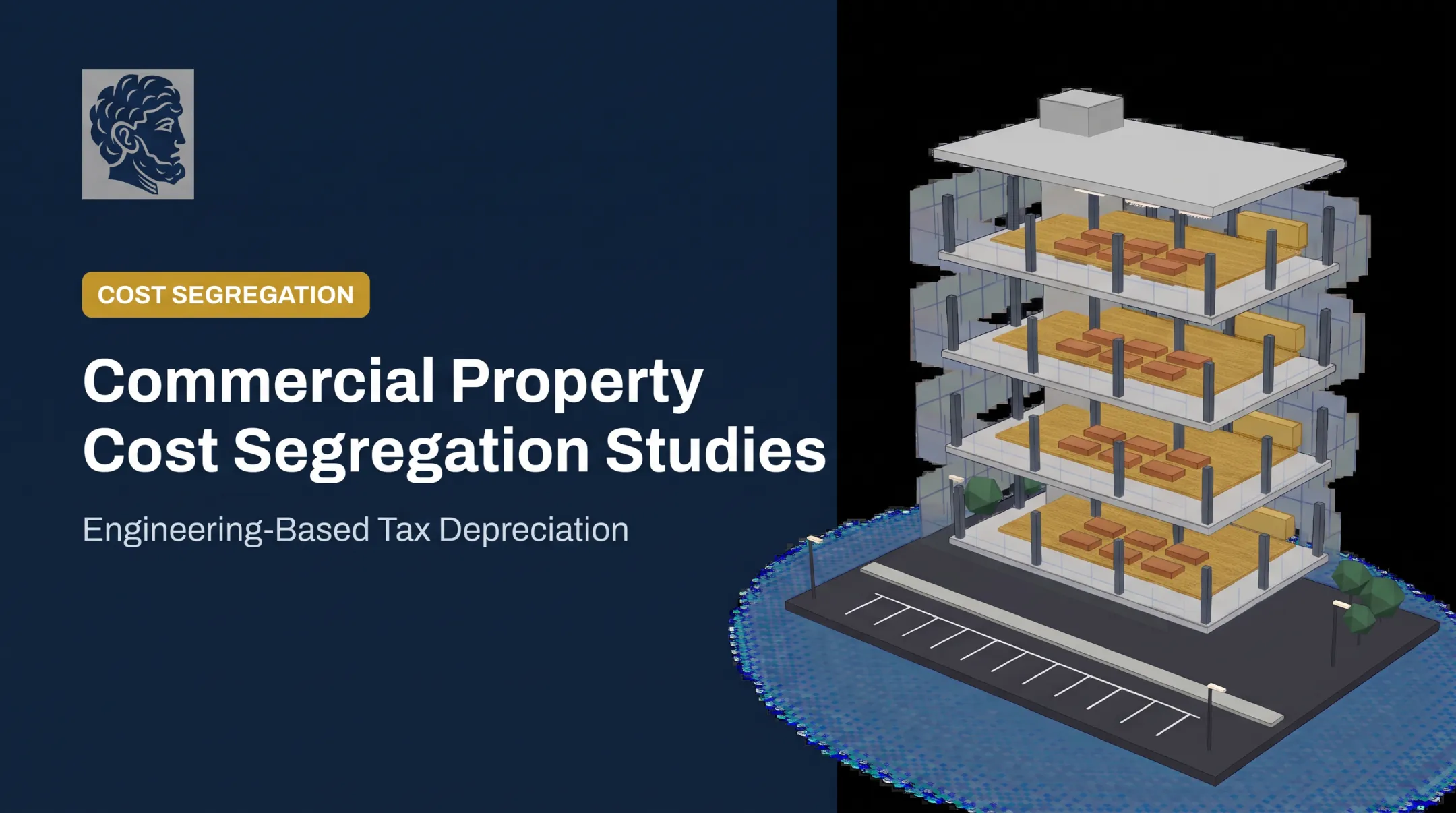
An engineering-based study breaks the property into components and assigns each the recovery period the law requires. Carpet and finishes can land in 5-year property, furniture and equipment in 7-year property, and paving and site work in 15-year property.
The IRS Audit Techniques Guide says a study built on construction knowledge is generally more reliable than one without it. Quality studies draw on plans, pay applications, invoices, and a field inspection or tour. The study front-loads deductions without changing total depreciable basis, and land stays nondepreciable.
How bonus depreciation affects the result
Bonus depreciation applies to tangible MACRS property with a recovery period of 20 years or less. Reclassified 5-, 7-, and 15-year components can qualify; the 27.5- and 39-year building cannot.
For property acquired after Jan. 19, 2025, and placed in service after that date, the rate is 100%, made permanent by P.L. 119-21. Earlier acquisitions follow the phase-down: 40% for 2025 placements and 20% for 2026. Certain used property can qualify if acquisition requirements are met.

What the study cannot do
A study does not:
- Decide whether a loss is passive or nonpassive
- Establish material participation
- Satisfy basis or at-risk requirements
- Guarantee any wage offset
Treat it as one part of a tax strategy. Your CPA determines how the results flow through the return and which limitations apply.
When Can Cost Segregation Losses Offset W-2 Income?
Why ordinary rental losses usually do not offset wages
Rental activities are generally passive, even when you participate. A passive loss generally cannot offset wages. It carries forward and can be used against passive income, through the rental special allowance, or on a fully taxable disposition of the entire interest to an unrelated person.
The special allowance reaches up to $25,000 for actively participating taxpayers, but it phases out between $100,000 and $150,000 of modified AGI. Most high earners get nothing from it.
The short-term rental pathway
An activity falls outside the rental definition if average customer use is 7 days or less, or 30 days or less with significant personal services. Calculate this from actual booking history.
Passing that test is only step one. You must also materially participate. Common paths include:
- Working more than 500 hours in the activity
- Working more than 100 hours and at least as much as any other individual
Courts look closely at proof. In Bailey v. Commissioner, the court disallowed a loss on an inn with 3-day average stays because contemporaneous time records were missing. In Lucero v. Commissioner, the court stressed that material participation requires regular, continuous, and substantial involvement.
Real estate professional status
You must satisfy both tests: more than half of your personal services in real property businesses, and more than 750 hours in them. You must also materially participate in the rental activity, or make the aggregation election.
A full-time W-2 job makes the first test hard. On a joint return, one spouse must meet both tests alone; services are not combined.
Case results show how strict this is. In Oderio v. Commissioner, a full-time employee could not borrow her spouse's activities. In Padilla, a log claiming 764 hours failed because much of the time was investor activity.
Cost segregation is the accelerator, not the eligibility test
The sequence matters:
- You own or operate a qualifying activity.
- You establish that losses are nonpassive.
- You complete a supportable study.
- Your CPA applies the deductions through the return and its limits.

Other business losses and the overall ceiling
Operating-business losses, including those from an S corporation, face stacked limits before they can offset W-2 wages:
- S corporation losses limited to stock and debt basis
- At-risk rules
- Passive-activity rules
- Section 461(l) excess-business-loss limit
For 2026, the draft Form 461 instructions list thresholds of $256,000 for individuals and $512,000 for joint returns. Excess losses become NOL carryovers, and post-2017 NOL deductions are generally capped at 80% of taxable income.
How to Evaluate and Implement the Strategy
Screen the property and taxpayer first
Before commissioning a study, review:
- Property type, depreciable basis, and land allocation
- Placed-in-service date and ownership structure
- Expected hold period
- Current and projected income
- Participation status
- Whether you have income the deduction can actually offset
A percentage-of-purchase-price estimate is not enough. The engineering opportunity and your ability to use the deductions both need review.
Calculate ROI on usable tax benefit
Compare the expected benefit with:
- The study fee
- When the deduction lands
- Your marginal rate and state treatment
- Carryforwards you may face
- Recapture on sale and any transaction plans
- The time value of earlier deductions
Illustration, with assumptions only: a $1,000,000 commercial purchase with $200,000 of land leaves $800,000 depreciable. If a study reclassifies $200,000 to 15-year property and 100% bonus applies, the first-year deduction on that portion is $200,000.

At a 35% marginal rate, that is about $70,000 of tax deferred, if the loss is usable. Actual results vary by property and taxpayer, and nothing here is guaranteed.
Complete an engineering-supported study
A typical engineering-supported study follows this sequence:
- Gather closing statements, plans, and construction records
- Complete a virtual or onsite tour
- Classify components and substantiate costs
- Deliver a report with a fixed asset schedule your CPA can use
Defensible classifications come from property-specific analysis, not rules of thumb.
Coordinate with the CPA
Your CPA decides depreciation treatment, elections, grouping, and passive-activity treatment. For an existing property, a change from an impermissible to a permissible method is a change in accounting method, generally reported on Form 3115 with a Section 481(a) catch-up adjustment.
Review the study before filing. Keep the report, source documents, participation logs, and return support in case the IRS asks questions.
Where Seneca fits
Seneca is an engineering-led commercial cost segregation provider that works with owners and their CPAs. It provides a projected ROI before engagement and a written fixed-fee proposal within 24 to 48 hours. Every study includes lifetime audit defense. That support covers documentation if questions arise; it does not guarantee a particular tax result.
What Can Limit or Delay the Tax Benefit?
Pass-through loss limitation order
For pass-through losses, limits apply in this order:
- Basis
- At-risk
- Passive activity
- Excess business loss

A large deduction may be limited or carried forward instead of offsetting wages.
Timing, sale, and future tax effects
- Timing: The placed-in-service date fixes the bonus percentage, and a later study does not change it
- Look-back: A look-back study can capture missed depreciation on the current return
- Recapture: Section 1245 recapture is ordinary income; unrecaptured Section 1250 gain is taxed at up to 25%
- State rules: Conformity varies. Tax Foundation's July 2025 report found 15 states offering first-year expensing to the same degree as the federal rule then in effect
Acceleration is a timing benefit, not permanent tax elimination.
Common mistakes
- Assuming every rental loss offsets wages
- Skipping contemporaneous participation logs
- Overstating basis
- Ignoring personal use or property-manager involvement
- Using unsupported classifications
- Commissioning a study without CPA review
Frequently Asked Questions
Can I use depreciation to offset W-2 income?
Depreciation can contribute to a business or rental loss. That loss must be nonpassive and must satisfy basis, at-risk, and excess business loss limits before it offsets wages.
Can S Corp losses offset W-2 income?
Not automatically. Losses depend on shareholder basis, at-risk rules, material participation, passive treatment, and the excess-business-loss limit.
Can you deduct business expenses against W-2 income?
Expenses of a separate business reduce that business's income. Ordinary unreimbursed employee expenses remain nondeductible as miscellaneous itemized deductions, with limited exceptions such as reservists and performing artists.
Does a cost segregation study by itself make rental losses nonpassive?
No. It changes the timing and classification of depreciation, not the character of the activity. You need a separate pathway, such as real estate professional status.
What is the short-term rental exception for offsetting W-2 income?
Average stays of 7 days or less take the activity outside the rental definition. You must still materially participate and keep contemporaneous records. Review it with a tax professional.
Can I use a cost segregation study on a property I already own?
Yes, often through a look-back study filed with Form 3115 and a Section 481(a) adjustment. Your CPA should confirm the adjustment is beneficial and properly reportable.