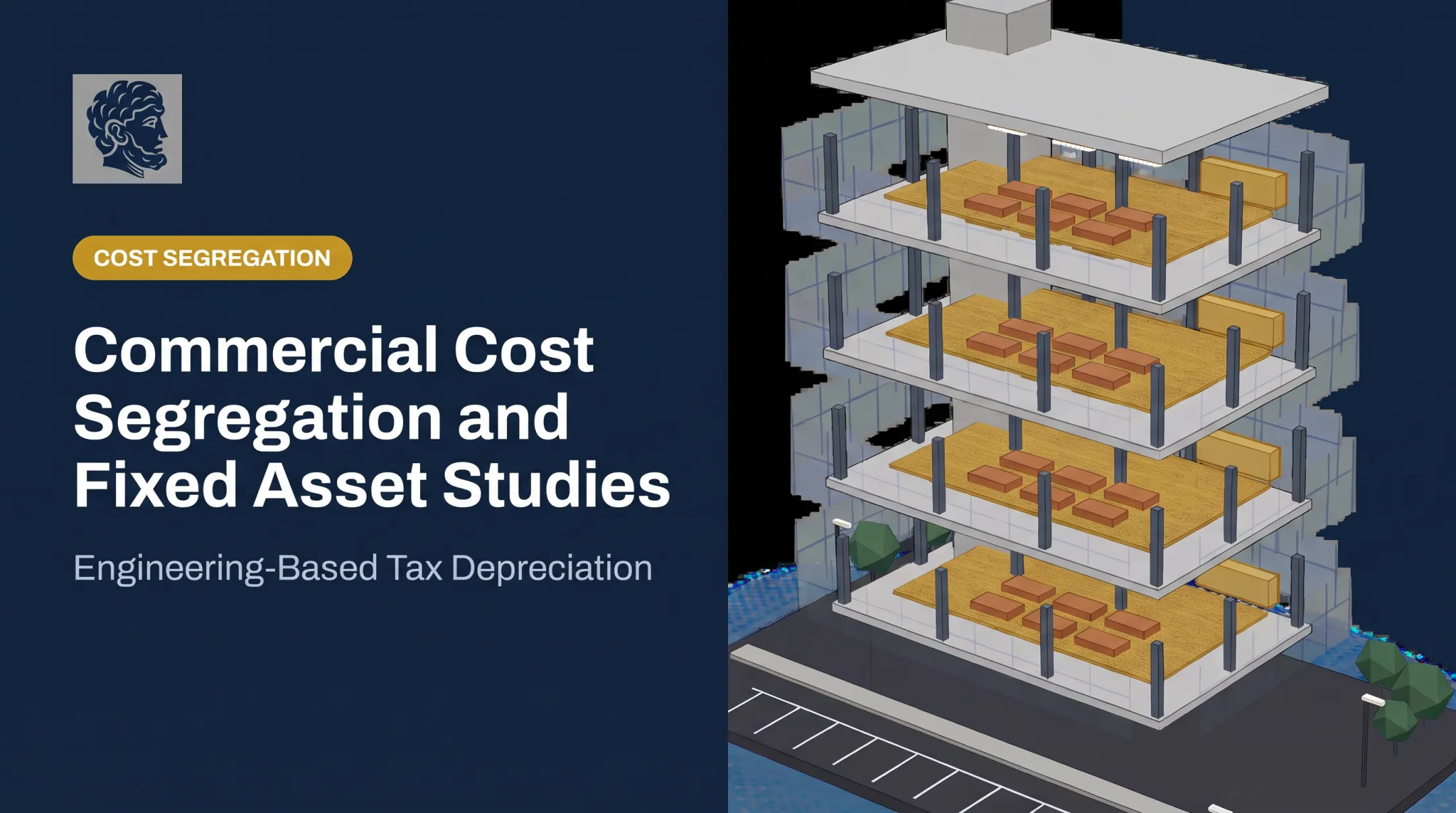

Without a study, a commercial building is usually depreciated as one asset over 39 years. An engineering-based review can separate shorter-lived components and change when the deductions arrive.
This guide is for dental practice owners, commercial property owners, DSOs, and CPAs. It covers qualifying components, ownership structures, timing, ROI, documentation, and how to judge study quality.
Key Takeaways
- Cost segregation is an engineering review that separates shorter-life components from the 39-year building.
- Operatory infrastructure, imaging areas, build-outs, and site work often offer the best opportunities.
- Results depend on ownership, tax position, placed-in-service date, records, and current federal and state rules.
- Get a property-specific feasibility estimate instead of relying on generic savings percentages.
What Is Commercial Cost Segregation for a Dental Clinic?
Cost segregation identifies building components that may qualify for shorter MACRS recovery periods, rather than treating the whole property as one long-lived asset. A study creates no new deduction. Total deductions over the property's life stay the same; the timing and classification change, subject to your ability to use them.
How the depreciation framework works
Under IRS Publication 946, the general recovery periods break down this way:
| Property class | General recovery period |
|---|---|
| Nonresidential real property | 39 years |
| Personal property, when properly classified | 5 or 7 years |
| Land improvements, when properly classified | 15 years |
Structural components and general building systems generally stay on the 39-year schedule. Qualified improvement property (QIP) means interior improvements to a nonresidential building after it was first placed in service. QIP carries a 15-year life. Elevators, building enlargements, and internal structural framework are excluded.
These are class lives, not automatic lives for dental systems. Bonus depreciation is now 100% and permanent for qualifying property acquired after January 19, 2025. Eligibility rules still apply, and it does not mean 100% of the building is written off.
What the study does and does not include
A study analyzes capitalized real property and improvements.
Dental chairs and imaging units the practice buys directly are equipment. They sit on the practice's own depreciation schedule, not in the study.
The study covers building-side work installed to support that equipment, including:
- Dedicated wiring
- Plumbing
- Vacuum or gas lines
Reconcile existing equipment schedules to the study so the same asset is not counted twice.
Why engineering and CPA review matter
Classification is fact-specific. There is no bright-line test separating §1245 personal property from §1250 real property. The courts look at permanence using the six Whiteco factors:
- Movability
- Design for permanence
- Intended duration
- Removal effort
- Damage on removal
- Manner of attachment In Hospital Corporation of America, the Tax Court distinguished property serving a building's general operation from property serving a special equipment function.

The engineering report supplies component-level analysis and documentation. Your CPA decides how the findings apply to your return and overall tax position.
Which Dental Clinic Components May Qualify?
Dental clinics differ from ordinary offices because each operatory or imaging area may need systems serving specific equipment. Depreciation treatment depends on what each system serves and how it is installed. Not every clinic utility is automatically eligible.
Operatory infrastructure and clinical connections
Candidates include:
- Dedicated plumbing to operatories and sinks
- Dedicated power for imaging and equipment
- Medical gas, oxygen, and vacuum piping serving procedure areas
- Nitrous oxide and compressed-air lines, where present
These lines serve functions like dental air and vacuum and piped oxygen or nitrous oxide at treatment units, according to the VA Dental Service Design Guide. That describes function, not tax class.
An analysis may separate general distribution from the branch connections dedicated to dental equipment. General building plumbing and electrical distribution generally remain 39-year property.
Imaging, sterilization, and specialty areas
Sterilizer, autoclave, and lab connections may support shorter lives where they serve specific equipment.
Lead shielding is trickier. Lead lining installed inside a wall assembly is generally treated as structural. Regulatory requirements alone, such as state x-ray barrier rules, do not set the depreciation class.
HVAC treatment also turns on permanence and purpose.
Interior finishes, casework, and built-ins
- Operatory casework and reception millwork
- Specialty and resilient flooring in clinical spaces
- Procedure and decorative lighting
- Nurse call, data, and security cabling
Removability, attachment method, and function drive each answer. Generic finish-carpentry examples in IRS guidance are not a dental-cabinet rule.
Exterior improvements and components that stay structural
These items may qualify as 15-year land improvements:
- Parking lots, sidewalks, and curbs
- Site lighting, signage, and fencing
- Landscaping and drainage
Foundations, structural walls, roof systems, general plumbing, general electrical distribution, and central HVAC usually remain in the building unless a specific exception applies.
When Does Cost Segregation Apply and How Is a Study Completed?
A cost segregation study can apply after major clinic property events. Common triggers include:
- Buying an existing clinic
- Constructing a building
- Completing a tenant buildout
- Adding operatories or renovating treatment areas
- Replacing specialized systems
One renovation invoice can hold four tax treatments: repairs, QIP, personal property, and structural work.

Ownership, leasing, and entity structure
- Practice owns the building: the practice holds the depreciable basis.
- Separate real estate entity leases to the practice: an LLC-owned clinic building can still qualify; the CPA decides which entity claims the deduction.
- Tenant funds the buildout: Under Publication 946, a tenant generally depreciates capital improvements it makes, and the landlord depreciates what it owns. Study tenant-owned buildouts in the year placed in service.
Whoever holds the basis generally gets the benefit. Passive activity rules, grouping, and related-party rent are CPA questions. Publication 925 explains that rental activity is generally passive, with real-estate-professional exceptions.
Timing and look-back studies
A study works best on the first return that includes the property, when project records and placed-in-service dates are fresh. A pre-acquisition estimate can put expected depreciation into underwriting before closing.
Existing clinics can use a look-back, provided the property is still owned. The automatic method change under Rev. Proc. 2025-23 (DCN 7) uses Form 3115 and a §481(a) adjustment, generally without amending prior returns. The CPA files and signs the form.
Study process and deliverables
- Preliminary estimate and feasibility review
- Information collection
- Site tour, virtual or onsite
- Component classification, cost allocation, and report
- Quality review and CPA handoff

Useful records include:
- Closing statement and purchase agreement
- Plans and contractor pay applications
- Invoices and renovation records
- Lease terms
- Prior returns and the current depreciation schedule The IRS Audit Techniques Guide lists quality elements such as expertise, methodology, interviews, unit costs, cost reconciliation, and a site visit. A good report ties each allocation to property facts, recovery period, cost support, and stated assumptions.
Evaluating the opportunity before engagement
Compare projected benefits against study fees, taxable income, cash flow, hold period, recapture, and state treatment. Seneca's engineering team provides a projected ROI and a written fixed-fee proposal within 24 to 48 hours, so owners and CPAs can decide before committing. Studies typically take 2 to 5 weeks.
Financial, Tax, and Compliance Considerations
Accelerated depreciation shifts the timing of deductions. It does not guarantee a cash saving. Outcomes depend on basis, tax rate, income, ownership, elections, and state rules.
Bonus depreciation, QIP, and Section 179
Property in the 5-, 7-, and 15-year classes can be bonus eligible, and 100% bonus is permanent for qualifying property acquired after January 19, 2025 (or under a binding contract after that date). Property acquired earlier falls under phase-down rates.
Section 179 can also cover QIP, roofs, HVAC, fire and alarm systems, and security systems, subject to limits. Confirm the current figures with your CPA.
Tradeoffs to weigh
- Recapture: §1245 gain is ordinary income up to depreciation taken; model the sale with your CPA.
- Passive limits: losses may be unusable against other income.
- Unused deductions: low taxable income can blunt the benefit.
- State conformity: states differ on bonus depreciation and §179. A COST conformity survey shows the split between rolling, static, and decoupled states.
- Replaced components: you may recognize a loss on removed parts through a partial asset disposition.

Seneca doesn't prepare state returns, so coordinate state treatment with your CPA.
Study quality also shapes audit risk, so provider selection matters as much as the elections themselves.
Provider-selection checklist
- Engineers prepare the study, with documented credentials
- Property inspection, virtual or onsite
- Component-level documentation tied to photos, quantities, or cost records
- Direct collaboration with your CPA
- Transparent written fixed fees
- Methodology that follows the IRS Audit Techniques Guide
- Audit support (Seneca includes lifetime audit defense)
The IRS does not prescribe a study format, and the taxpayer remains responsible for substantiating deductions. Treat rule-of-thumb percentages and desktop models with caution.
Conclusion: Making a Dental Clinic Cost Segregation Decision
The opportunity comes from the clinic's actual components and ownership structure, not square footage, price, or the "dental office" label. Your next steps are practical:
- Gather the closing statement, plans, invoices, and prior returns.
- Ask your CPA to review tax capacity and timing.
- Request a property-specific feasibility estimate before commissioning a study.
Frequently Asked Questions
What is cost segregation?
Cost segregation is an engineering-based allocation of a property's components into appropriate depreciation categories. Final tax treatment depends on the property facts and current IRS rules.
What factors should be considered when making changes to the dental office environment?
Consider the type of change, who owns it, whether it serves specific dental equipment, and how permanently it is attached. Also note the placed-in-service date, your records, and whether removed components need separate treatment.
Can a leased dental clinic use cost segregation?
Tenants can analyze qualifying leasehold improvements they own and depreciate, while the landlord handles the building's basis. Coordinate among tenant, landlord, and CPA.
Does cost segregation apply to dental equipment?
Equipment the practice buys directly stays on its own schedule. A study covers building-side infrastructure supporting that equipment and should avoid duplicating existing assets.
Can an existing dental clinic use a look-back study?
Yes, if you still own the property. Eligibility depends on current filing procedures, records, and your CPA approving the accounting-method change.