
Introduction
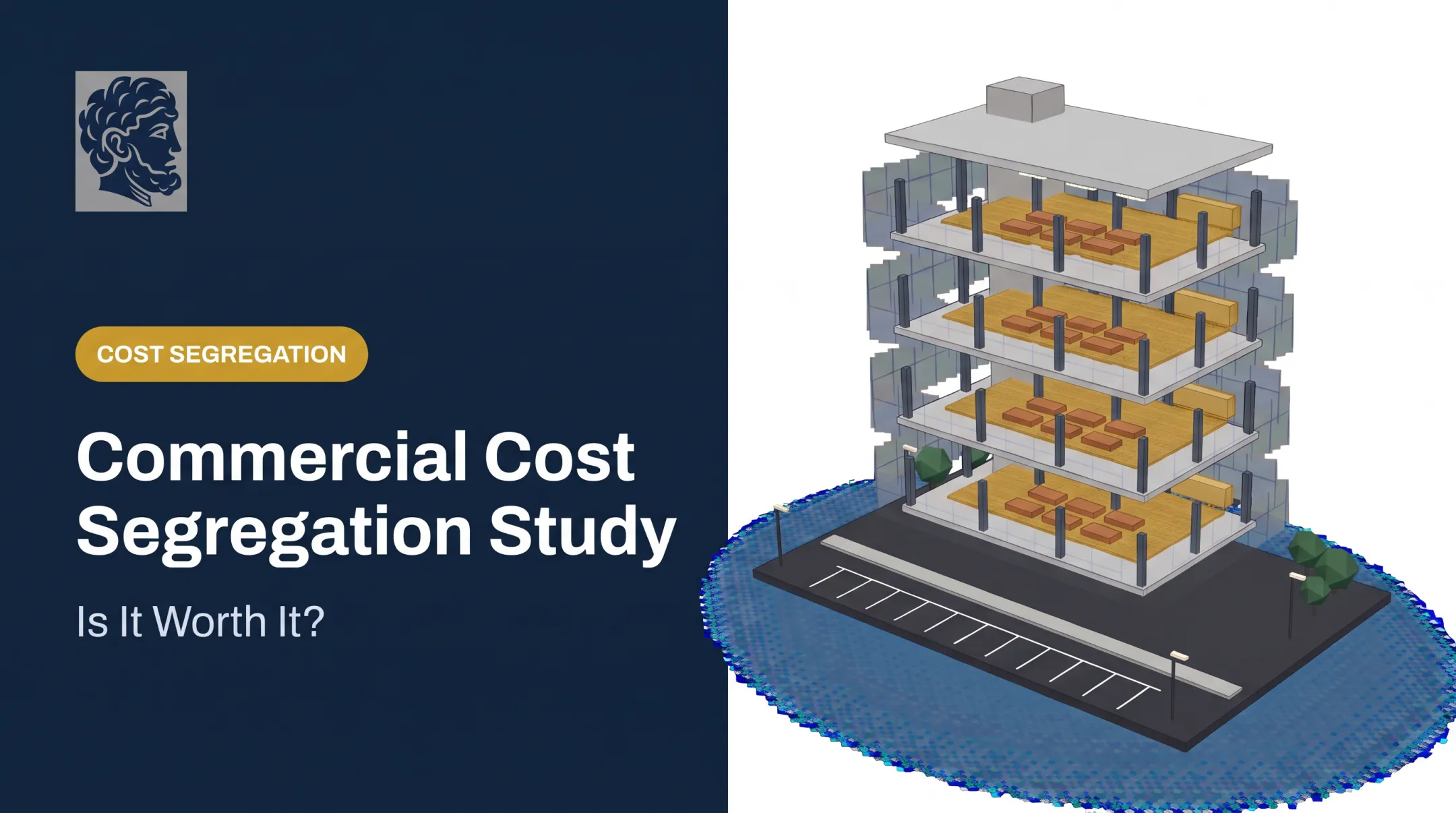
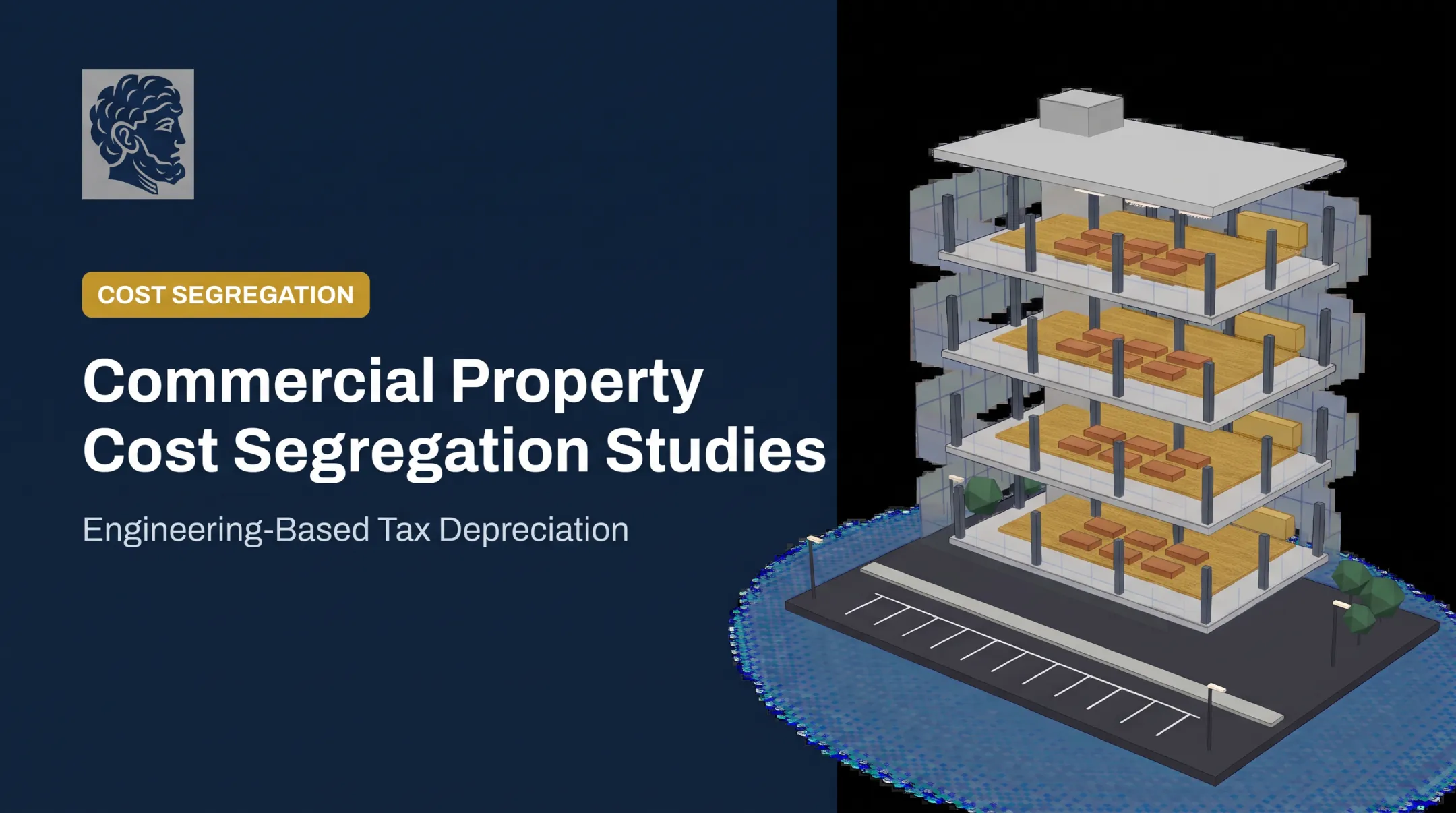
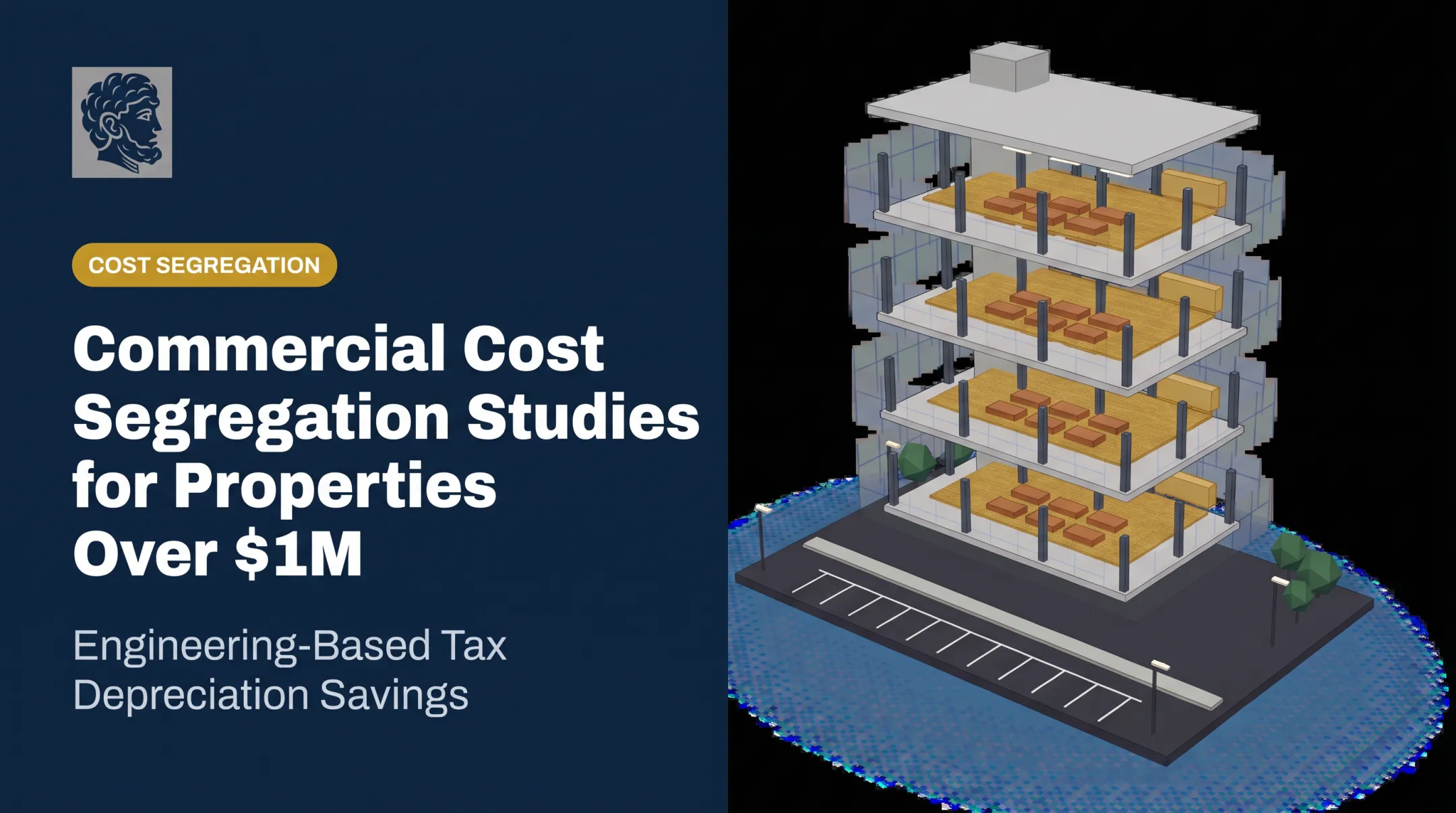
A commercial building is not one asset. It holds carpet, dedicated electrical runs, parking lots, signage, and specialty lighting, along with the structure itself.
If all of it sits on a single 39-year schedule, deductions that could arrive in years one through fifteen get pushed out for decades.
Cost segregation sorts those components into the right recovery periods. This guide is for commercial property owners and CPAs. It covers:
- How studies work
- What benefits they provide
- Which properties are strong candidates
- How to test the opportunity before paying for a full study
Key Takeaways
- Cost segregation moves qualifying personal property and land improvements into shorter recovery classes.
- The main benefit is earlier deductions and cash flow, not more total depreciation.
- Basis, tax position, hold period, state rules, and bonus depreciation law shape the result.
- A defensible study pairs engineering, tax expertise, documentation, and CPA coordination.
What Is Commercial Cost Segregation?
What a commercial cost segregation study does
Cost segregation is an engineering and tax analysis. It identifies components that may qualify for shorter recovery periods than the building, then allocates supported costs to each class. The IRS Audit Techniques Guide says there is no mandated study format, so the quality of the support matters.
Under IRS Publication 946, nonresidential real property generally has a 39-year recovery period. Other property may fall into 5-, 7-, or 15-year classes when the rules support it. Typical categories:
- 5- and 7-year: carpet and specialty flooring, decorative lighting, dedicated electrical and plumbing serving equipment, data and security cabling
- 15-year: paving, curbing, sidewalks, site lighting, fencing, landscaping, signage, drainage
- 39-year: the structure and general building systems
- Land: not depreciable

Always verify terminology against current IRS guidance. Classification turns on function, attachment, and permanence, not on what an item is called.
Why the strategy can affect cash flow
Depreciation is a deduction, not a dollar-for-dollar credit. Moving deductions earlier lowers taxable income sooner, and those tax savings can fund operations, debt paydown, or the next acquisition. The benefit is the time value of money, and it depends on whether the owner can actually use the deductions.
What cost segregation does not mean
- It does not make every component eligible for accelerated treatment.
- It should not rest on rule-of-thumb percentages. The IRS guide treats unsupported percentages with caution.
- It must account for land, structural components, elections, and state differences.
- It can change the character of gain on sale through depreciation recapture.
How Does a Commercial Cost Segregation Study Work?
Collect property, construction, and tax records
Owners and CPAs typically supply:
- Closing statements and purchase agreements
- Plans, specifications, and construction invoices or pay applications
- Renovation records and photos
- Prior depreciation schedules and placed-in-service dates
Better records mean stronger cost allocations. For acquisitions, the IRS guide cautions that applying a pro-rata step-up factor to improvements and personal property is not an acceptable allocation method.
Perform engineering and property analysis
Engineers review drawings, tour the property (in person or virtually), and evaluate flooring, lighting, wiring, plumbing, HVAC, millwork, site work, and specialized equipment.
They test each component against key questions:
- Does it serve a business function?
- Is it removable or specialized?
- Is it inherently structural?
The IRS guide applies the Whiteco permanence factors here, and movability alone does not decide the answer.

Allocate costs and apply tax analysis
Direct and indirect costs are assigned to identified components and reconciled to total project cost. The classifications then feed the depreciation calculations.
Before implementation, the owner's CPA should weigh:
- Tax rate and entity structure
- Taxable income and passive activity position
- State treatment and available elections
Prepare the report and depreciation schedules
A complete deliverable includes:
- Asset classifications and cost allocations
- Recovery periods and methodology
- Updated depreciation schedules
- Stated assumptions and supporting documentation
The report should be detailed enough to support its classifications if the IRS asks. Audit defense is a practical factor when you compare providers.
Address properties already in service
A lookback study applies to a property acquired, built, or renovated in a prior year. A qualifying correction may use an automatic accounting method change with Form 3115 and a §481(a) adjustment, as described in Rev. Proc. 2025-23.
That route can avoid amending prior returns, but eligibility depends on the asset's history and current procedures. Coordinate with the CPA rather than assuming one procedure fits every taxpayer.
What Are the Main Benefits?
Accelerated depreciation and potential tax savings
Eligible components depreciate over shorter periods than the building, which can increase deductions in early years. Total lifetime deductions stay the same. Only the timing changes.
A simple illustration, not a guaranteed result: suppose a $5 million building purchase has $4 million of depreciable basis after excluding land. A study might support moving $1 million into 5-, 7-, and 15-year classes.

That $1 million would no longer be spread over 39 years, and qualifying short-life property may be eligible for bonus depreciation. Your CPA would model the actual figures.
Improved near-term cash flow
Earlier deductions can reduce taxable income and preserve cash for debt service, tenant improvements, renovations, or distributions. The benefit is practical only if the taxpayer has enough income, or can otherwise use the resulting tax attributes.
Better support for renovations and partial dispositions
Component-level records show the remaining basis of items later replaced, such as flooring, lighting, HVAC, or roofing. Under Treas. Reg. §1.168(i)-8, a taxpayer may be able to elect to recognize remaining adjusted basis of a disposed component as a loss.
This is a separate analysis, not an automatic result of a study, and the election is generally time-sensitive. Have your CPA review it promptly.
More informed investment and tax planning
Component-level data helps owners compare acquisition, construction, renovation, refinancing, and hold-period scenarios on an after-tax basis. Results may interact with:
- Bonus depreciation at 100% for qualified property acquired after January 19, 2025 under OBBBA (IRS Notice 2026-11)
- Section 179, with a 2026 limit of $2.56 million
- Section 179D, which does not apply to property whose construction begins after June 30, 2026
- Like-kind exchanges and passive activity rules
Cost segregation does not make the 39-year building itself bonus-eligible.
Important limitations and tradeoffs
- A study carries an upfront fee, and the benefit may be small when basis is low or few components qualify.
- Owners who cannot use the deductions gain little.
- Section 1245 depreciation is recaptured as ordinary income on a taxable sale.
- States may not conform to federal bonus depreciation. California, for example, does not.
- Accelerated deductions shift tax rather than permanently eliminate it.
Which Commercial Properties and Situations May Benefit?
Property types with potentially meaningful opportunities
Properties with heavy build-outs, specialized systems, or site work often show more opportunity:
- Retail and restaurants: kitchen build-outs, parking fields, pylon signs
- Hospitality: FF&E, finishes, back-of-house equipment
- Medical, dental, and care facilities
- Offices and office condos
- Warehouses and industrial facilities with truck courts and dock equipment
- Manufacturing plants and production facilities
- Mixed-use buildings, where shared structure and site work must be split first
Property type alone does not decide suitability. Actual construction, use, cost, improvements, and component mix do.
Common components evaluated
- Removable fixtures and specialty lighting
- Dedicated electrical or plumbing for equipment
- Interior finishes and cabinetry
- Parking areas, sidewalks, landscaping, fencing, and signage
- Tenant-specific or process improvements
Classification depends on design, use, attachment, and function. In the IRS guide's example, 15% of an electrical distribution system serving specialized kitchen equipment is treated as §1245 property. General building electrical, by contrast, is generally 39-year property.

Timing and lookback opportunities
Owners usually evaluate a study at acquisition, new construction, a major renovation, or the year of placement in service. An older property may still qualify for a lookback analysis. Owning a building for years without a study does not by itself forfeit the deduction. Confirm implementation requirements and acquisition-date tests with your CPA.
How Should Owners and CPAs Evaluate Whether a Study Is Worthwhile?
Start with a preliminary ROI screen
Compare the estimated incremental tax benefit and its timing against the study fee, CPA implementation time, and expected state tax effects. A responsible estimate needs:
- Depreciable basis excluding land
- Placed-in-service date
- Property type and renovation history
- Likely qualifying components
- Owner tax position and expected hold period
Consider the owner's ability to use the deductions
Taxable income, ownership structure, loss carryforwards, and elections all matter. Rental activity is generally passive unless an exception applies, and IRS Publication 925 explains how those limits work. Partnership, S corporation, and trust structures add partner- or owner-level limits. Confirm the projected benefit with the CPA before relying on it.
Review federal, state, and transaction implications
Check current federal depreciation and bonus rules, plus state conformity for each relevant state. Include recapture, refinancing, sale plans, and any §1031 exchange. Exchange planning should begin before the sale is under contract, because §1245 property given up without matching §1245 property received can trigger recapture.
Choose a provider based on documentation and technical process
Look for:
- Engineering involvement and a site tour
- Component-level cost support tied to documents
- Transparent assumptions and methodology
- Tax coordination with your CPA
- Detailed reports, secure document handling, and written pricing
- Post-study and audit support
Be wary of percentage-only estimates, generic reports, and providers who cannot explain their methodology. The IRS Cost Segregation Audit Techniques Guide singles out modeled and rule-of-thumb approaches for scrutiny because the supporting documentation was never created.
Use a pre-engagement ROI analysis to decide next steps
Seneca is an engineering-led provider for commercial owners and CPAs who want an estimate and projected ROI before committing. Its engineering team works directly with the client's CPA, from estimate to final deliverable.
Evaluation factors worth comparing:
- Written fixed-fee proposals within 24 to 48 hours
- Studies built to the IRS Audit Techniques Guide, typically completed in 2 to 5 weeks
- Lifetime audit defense while the taxpayer owns the property
- NDAs available for sensitive projects
None of these promises a particular tax result. Seneca's estimate is a first look, not a study.
Frequently Asked Questions
How does a cost segregation study work?
A provider reviews records, tours the property, classifies components, allocates costs, and prepares a report with depreciation schedules. The owner's CPA then implements the results on the return.
What is cost segregation?
Cost segregation identifies property components that may be depreciated over shorter recovery periods than the main commercial building. Costs are allocated to each class with supporting documentation.
Should I do a cost segregation study?
Weigh depreciable basis, property complexity, tax position, ability to use deductions, hold period, study cost, and current tax rules. A preliminary ROI estimate helps decide.
What type of property is best for cost segregation?
Properties with specialized equipment, substantial interior improvements, land improvements, or business-specific systems, such as restaurants, hotels, and medical facilities. Suitability is property-specific.
What is the difference between cost segregation and bonus depreciation?
Cost segregation identifies and classifies eligible assets. Bonus depreciation is a separate tax rule that may accelerate deductions for qualifying property. Neither makes the whole building immediately deductible.
What are the rules for cost segregation bonus depreciation in 2026?
Qualified property acquired after January 19, 2025 may be eligible for 100% bonus depreciation, with interim guidance in Notice 2026-11. Eligibility, placed-in-service dates, and limits must be verified for each taxpayer and property.